

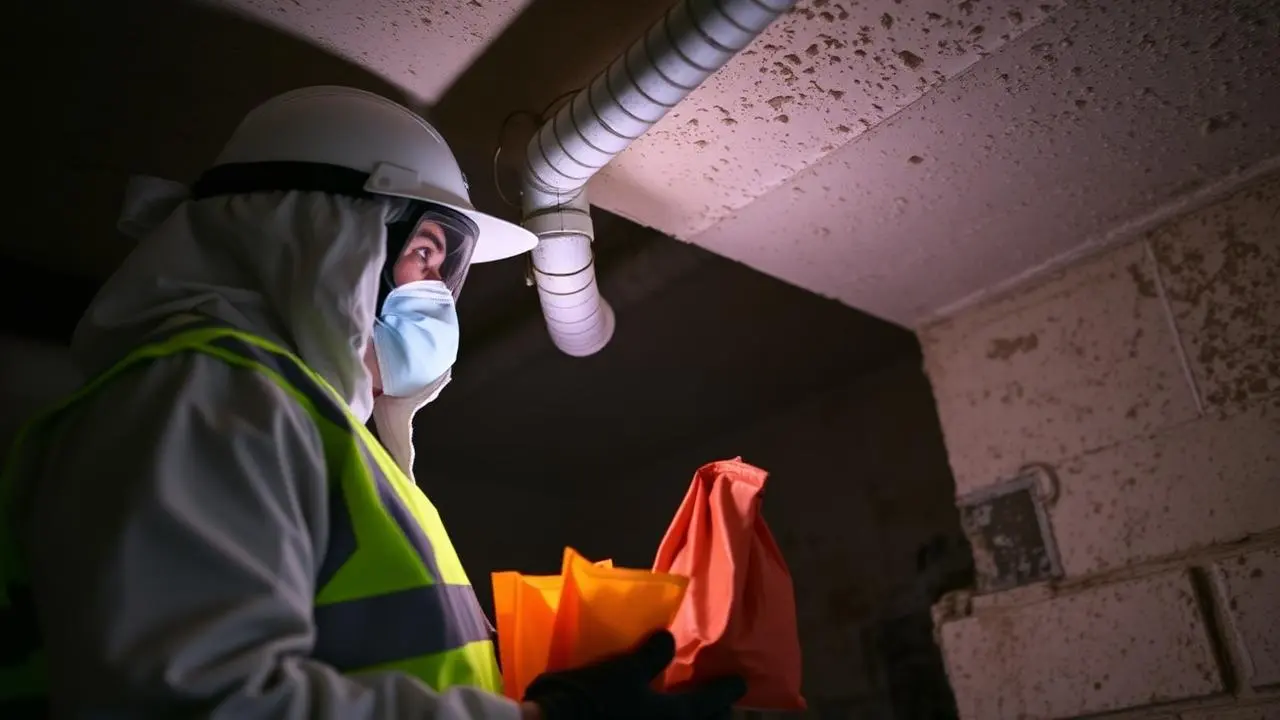




When an asbestos survey is required
If you are a dutyholder under the Control of Asbestos Regulations 2012 and your building was constructed or refurbished before 2000, you must manage asbestos-containing materials. A management survey is the standard requirement for normal occupation and ongoing maintenance. A refurbishment or demolition survey is needed before any intrusive works that could disturb asbestos. Failure to identify asbestos before work begins is one of the most common prosecution routes under the regulations.
Types of asbestos survey
The right survey depends on what is happening in the building. We help you choose the correct type and scope before booking.
- Management survey — standard for occupied buildings; identifies accessible asbestos materials
- Refurbishment survey — required before intrusive refurbishment works; more destructive inspection
- Demolition survey — required before demolition; fully destructive inspection of all areas
- Reinspection survey — annual or periodic re-check of known asbestos materials
What the survey covers
A competent surveyor inspects accessible areas of the building, takes samples where suspect materials are found, and sends them to a UKAS-accredited laboratory for analysis. You receive a survey report, an asbestos register, a material risk assessment, and a recommended reinspection programme. The register should be shared with anyone who may disturb building fabric — contractors, maintenance staff and facilities managers.
Common locations in London buildings
Asbestos is most commonly found in textured coatings, floor tiles and adhesives, pipe lagging, boiler insulation, ceiling tiles, soffits, guttering, fire breaks, and around electrical switchgear. In converted Victorian and Edwardian properties, asbestos cement is often present in outbuildings, roof sheets and soil pipes. In commercial premises, sprayed coatings and insulating board are more common in plant rooms and service voids.
Linking asbestos and fire safety
Asbestos and fire safety often overlap in the same building. Fire-stopping materials in older buildings may contain asbestos, and disturbing them during fire door or compartmentation works can release fibres. We coordinate asbestos and fire risk assessment visits so that any planned fire safety upgrade is informed by the asbestos register first, avoiding accidental disturbance and regulatory breaches.
Pricing and turnaround
Management surveys start at £225 for a small commercial unit or flat and scale with floor area, number of rooms and accessibility. Refurbishment and demolition surveys are priced after a brief scope call. Reports are normally issued within five working days of the survey, with faster turnaround available for urgent projects.
The dutyholder obligation under Regulation 4
Regulation 4 of the Control of Asbestos Regulations 2012 places an explicit duty to manage on whoever has responsibility for the maintenance and repair of non-domestic premises, including the common parts of residential buildings built or refurbished before 2000. That duty requires the dutyholder to take reasonable steps to find asbestos-containing materials, presume materials contain asbestos unless there is strong evidence otherwise, keep an up-to-date record of location and condition, assess the risk of exposure, and prepare a written plan for managing that risk. The Health and Safety Executive treats a missing or out-of-date asbestos register as evidence of a systemic management failure, and it is a recurring basis for enforcement notices and prosecutions when intrusive work goes ahead without one. We produce documentation built specifically to satisfy this duty, not a generic sampling report that leaves the management plan for the dutyholder to construct themselves.
How a management survey is actually carried out
A surveyor works systematically through every accessible room, void, riser and external area, visually identifying materials that could contain asbestos based on age, appearance and known building practice for the construction period. Suspect materials are sampled using minimally intrusive techniques — small cuts, drilled cores or surface scrapes — sealed and labelled against a location reference, and sent to a UKAS-accredited laboratory for polarised light microscopy analysis. Areas that are locked, boxed in, or require destructive access beyond the survey's scope are recorded as unable to be inspected rather than presumed clear, because a management survey is deliberately non-destructive and cannot certify areas it has not actually opened up. The surveyor also records the condition and accessibility of each identified material, since a sealed, undamaged material behind a panel carries a very different risk score to the same material exposed in a busy corridor.
Refurbishment and demolition surveys: what changes
A refurbishment or demolition survey is a fully intrusive inspection carried out once the area is vacated and services isolated, because it needs to expose everything that intrusive building work might disturb — behind partitions, above ceiling voids, within floor and wall cavities, and inside duct runs. This is destructive by design: the surveyor lifts floor coverings, opens up voids and removes sections of finish that would never be disturbed during a management survey of an occupied building. Because of this, a refurbishment or demolition survey cannot usually be carried out while a building remains occupied or trading, and the scope has to be agreed against the actual works drawings so nothing due to be disturbed is missed. Relying on an old management survey before intrusive works is one of the most common and most serious compliance failures we are asked to remedy after the fact.
- Full access to all areas affected by the planned works
- Destructive inspection of voids, cavities and duct runs
- Survey scoped against the actual works drawings, not the whole building
- Carried out with services isolated and the area vacated
- Cannot be substituted with an existing management survey
Sampling, analysis and turnaround
Suspect samples travel to a UKAS-accredited laboratory the same day or next working day after the survey, and results are typically returned within three to five working days for a standard turnaround, with a faster paid service available where a project programme cannot wait. Each result confirms the fibre type present — chrysotile, amosite or crocidolite — which materially changes the risk score and the removal method required if the material later needs to come out. We do not release a final register until every sample result is back, because issuing a report with pending results creates exactly the kind of ambiguity that leads to a material being wrongly presumed clear.
The asbestos register and management plan in practice
The register is only useful if the people who might disturb the fabric can actually find and understand it before they start work. We format it as a plain-English document with a floor plan reference for every identified or presumed material, a risk score based on condition and disturbance likelihood, and a photograph, rather than a technical appendix that sits unread in a filing system. The accompanying management plan sets out what condition monitoring is required, at what interval, and the trigger points for moving from management to encapsulation or removal. We hand this to the dutyholder in a form that can be issued directly to contractors before permit-to-work is granted, since the single most common cause of accidental disturbance is a contractor who was never shown the register in the first place.
Reinspection and keeping the register current
A management survey does not expire, but the materials it identifies do change condition over time, and the regulations expect the register to be kept current rather than treated as a one-off exercise. We recommend a reinspection interval based on the risk score of each material — typically annual for anything in fair or poor condition or in a high-traffic area, and longer for materials in good condition and low disturbance locations. Reinspection is a lighter-touch visit focused on the known locations rather than a full resurvey, which keeps ongoing cost proportionate, and any change in condition is reflected in an updated register issued straight after the visit so the record never drifts out of line with reality.