



North London access and the correct premises
The official Brent Cross visitor guide identifies NW4 3FP and access from the North Circular A406 at the Brent Cross Interchange. Provide the unit number, level, tenant name and exact meeting point too. Visitor directions do not establish permission to enter service corridors or restricted areas: your site contact must arrange any access needed for the scope. Source: Brent Cross official “Getting here” guide.
Stockroom and delivery changes during trading
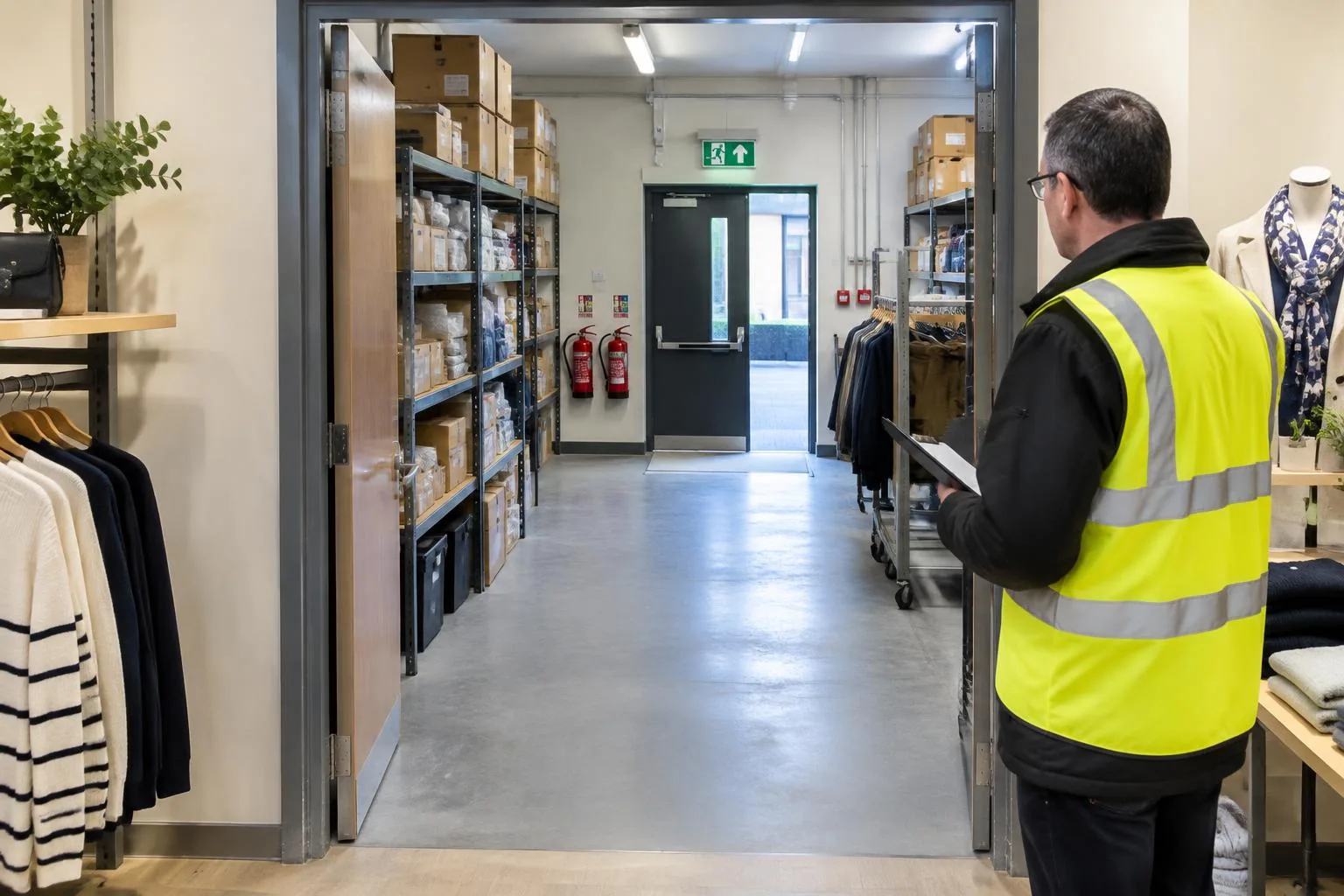
A busy tenant unit can have very different conditions before opening, during delivery and at peak trading. Explain where pallets and packaging are held, how staff keep escape doors usable and whether the rear route is shared. We assess the actual arrangements and ask for relevant management information rather than assuming the public mall is the only escape route.
Refits, pop-ups and food-service units
Changing a shop to food service, adding equipment or subdividing storage can change the fire-risk profile. Share the proposed layout, process risks and fire-safety documentation before commissioning. A pop-up or promotional activation may also require event-specific coordination. Building control, landlord consent and centre fit-out acceptance remain separate from the FRA.
Your unit, the centre and the boundary between them
A shopping-centre fire risk assessment for a tenant considers the premises you control and how occupants reach safety through the wider building. The centre’s assessment does not automatically cover your stock, equipment, staff or fit-out. Article 22 of the Fire Safety Order requires responsible persons sharing premises to cooperate and coordinate. Ask centre management for the relevant fire strategy, evacuation arrangements and shared-system information; record any unavailable evidence as a limitation, not an assumption.
- Sales floor, counters and customer circulation
- Stockrooms, staff rooms and delivery access
- Your doors, escape paths and connections to shared routes
- Tenant alarm interfaces, emergency lighting and management records
What the tenant assessment includes
We inspect accessible areas in person, identify hazards and people at risk, evaluate the precautions and produce a written prioritised action plan. We consider ignition sources, combustible stock, electrical equipment, housekeeping, escape arrangements, staff training and people who may need assistance. A tenant FRA is not a fire-engineering design, destructive compartmentation survey, alarm commissioning test or sprinkler certification. Those instructions must be scoped separately.
- Walk the unit and accessible routes with the site contact
- Review the relevant centre information and service records
- Check the effect of shutters, displays and stock on escape
- Record responsibilities, evidence gaps and recommended actions
A fixed quote based on scope, not the centre’s name
Tell us the unit’s area, number of levels, intended use and opening or review deadline. Send plans if available and explain kitchens, mezzanines, unusual processes or restrictions on access. We confirm the scope and fixed fee before booking. Multiple units, whole-centre management, specialist testing and complex fit-outs need a scope discussion rather than a generic floor-count estimate. Any VAT treatment and separately instructed work are explained in the quote.
Before opening, after a fit-out and during trading
Do not treat the report as a guaranteed centre approval or a one-off certificate. Arrange a suitable assessment for the completed operating arrangement before staff and customers are exposed to unmanaged risk. Review it when there is reason to suspect it is no longer valid or after a significant change. New racking, stock, cooking equipment, occupancy, partitions or escape arrangements can trigger a review. The law does not set a universal annual expiry date for every shop.
Shops are a real enforcement priority
Government fire-protection statistics for England, April 2025 to March 2026, report 8,932 fire-safety audits of shops: 18% of the 50,195 audits across premises types. Across all audited premises, 60% had a satisfactory outcome. These are fire and rescue authority audits, not privately commissioned FRAs, shopping-centre fire counts or a prediction of whether your unit will fail. Source: GOV.UK, Fire prevention and protection statistics, year ending March 2026.
Sources and review
Reviewed 14 October 2026. Legal duties, guidance and enforcement statistics are different kinds of evidence.
- Fire Safety Order 2005: Articles 3, 9 and 22
- Fire safety risk assessment: offices and shops
- Fire safety responsibilities under Section 156
- Fire prevention and protection statistics: England, April 2025 to March 2026
- Westfield London: address and opening hours
- Westfield Stratford City E20
- Brent Cross: getting here