

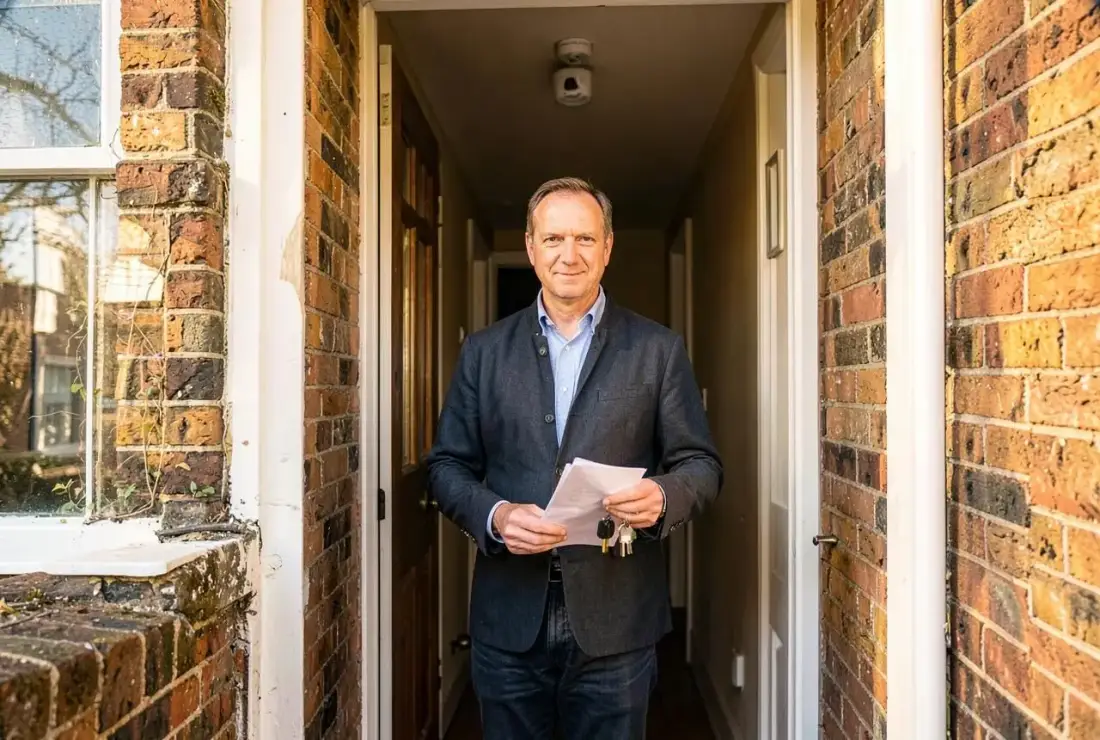




The duties every landlord holds
Fire safety for landlords is not one regulation but a stack of them, and they land from different directions. The Smoke and Carbon Monoxide Alarm (England) Regulations 2015, as amended in 2022, require a smoke alarm on every storey used as living accommodation and a carbon monoxide alarm in every room with a fixed combustion appliance other than a gas cooker, with faulty alarms repaired or replaced as soon as reasonably practicable once reported. The Electrical Safety Standards Regulations require an electrical installation condition report every five years. Gas Safety Regulations require an annual gas safety check by a Gas Safe registered engineer. Furniture supplied in a let property must meet the Furniture and Furnishings (Fire) (Safety) Regulations. And the Housing Health and Safety Rating System gives the council power to act on fire hazards independently of all of the above.
- Smoke alarm on every storey used as living accommodation
- CO alarm in every room with a fixed combustion appliance
- Alarms tested at the start of every tenancy
- Electrical installation condition report every five years
- Annual gas safety check and certificate to the tenant
- Fire-safe furniture and furnishings
When a written fire risk assessment is required
The Fire Safety Order does not apply inside a single private dwelling let to one household, so a standard single-family let does not itself need a fire risk assessment. It applies as soon as there is a shared element. If the property is a house in multiple occupation, the shared areas fall within the Order and a written assessment is required — licensing officers routinely ask for it, and a licence application without one is a licence application that stalls. If the flat sits in a building containing two or more dwellings, the common parts require an assessment held by the freeholder, RTM company or managing agent. If you own the freehold of the building your tenants live in, both duties are yours.
HMO duties in detail
HMOs carry the heaviest fire safety burden because the risk profile is genuinely higher: more households, more ignition sources, more people unfamiliar with each other's habits and, often, sleeping accommodation on upper floors served by a single stair. Expect to need interlinked detection appropriate to the LACORS guidance for the property type, fire doors to bedrooms and risk rooms with intumescent strips and self-closers, a protected escape route free of storage, emergency lighting where the escape route is long or unlit, and clear management arrangements for testing and record keeping. Mandatory licensing applies to HMOs with five or more occupants forming two or more households; additional and selective licensing schemes vary by borough and catch far smaller properties.
- Interlinked detection to LACORS standard for the property type
- FD30S fire doors to bedrooms, kitchens and risk rooms
- Protected escape route kept clear of storage
- Emergency lighting where required by layout
- Weekly alarm testing with a written log
- Written fire risk assessment, reviewed annually
The mistakes that cost landlords money
Three failures account for most of the enforcement action we see. The first is battery alarms in an HMO where interlinked mains detection is required — cheap to fix before an inspection, expensive afterwards. The second is fire doors that have been replaced during a refurbishment with ordinary internal doors, or fitted correctly and then propped, painted over or stripped of their closers. The third is storage in the escape route: bikes, buggies, boxes and furniture in a hallway that is the only way out. None of these are complicated to correct, and all of them are visible in an hour's inspection, which is exactly why enforcement officers look for them first.
What an assessment does for you commercially
Beyond compliance, a current written assessment resolves arguments. It is the document that gets an HMO licence issued rather than queried, satisfies an insurer at renewal, answers a buyer's solicitor during a sale, and demonstrates to a court that you took reasonable steps if a tenant claims otherwise. It also prevents money being spent on the wrong things: most landlords who ask us to specify works before an assessment end up spending more than the assessment would have told them to.
How we work with landlords
Most landlord instructions are single properties, and we price and attend them the same way we handle a portfolio: fixed fee agreed in writing, a named IFSM-registered assessor, survey within two to five working days, PAS 79 report within 24 hours, and a call afterwards to explain what to do first. If you hold several properties, they go on one renewal calendar with one report format, and the per-property rate drops from the second property upward. We do not carry out the remedial work we recommend, so there is nothing on the action plan that is there to sell you something.