





Fire RiskSpecialists

    Hospitality

    Fire risk assessments for hotels and hospitality from £349

    Fire risk assessments for hotels, guest houses, serviced apartments and aparthotels in London. Sleeping risk, guest evacuation, kitchens and licensing evidence.
    IFSM registeredNFRAR listed24-hour reports£5M insured
    Fire risk assessments for hotels and hospitality
    AudiKiaGB NewsBudgens
    The short answer

    Hotels, guest houses, serviced apartments and aparthotels are sleeping accommodation, which puts them in the highest-scrutiny category under the Fire Safety Order: guests are unfamiliar with the building, asleep, and often impaired. Fire Risk Specialists assess hospitality premises across London — bedroom compartmentation, protected escape routes, alarm category, night staffing and guest instruction, plus the kitchen, bar and plant risks that sit under the rooms — and deliver a PAS 79 report within 24 hours that stands up to a fire service audit.

    020 3951 4856

    £349

    Starting price, all inclusive

    24hr

    Written PAS 79 report

    1,000+

    Buildings assessed

    £5M

    Public liability insurance

    From

    £349

    Guest houses and small hotels

    Alarm

    BS 5839-1

    Installed category checked against need

    Doors

    Sampled by room

    Photographed and listed for maintenance

    Survey timing

    Out of hours

    No disruption to trading

    What you get

    Everything included, nothing subcontracted.

    What is covered as standard on every assessment we carry out.

    Sleeping risk done properly

    Bedroom doors, corridor protection and alarm category assessed against the guests actually staying.

    Kitchens and plant included

    Extract ducting, suppression, gas isolation and cellar risks assessed alongside the accommodation.

    Audit-ready

    Reports written for the questions a fire safety officer asks on an unannounced visit.

    Out-of-hours surveys

    We work around occupancy, checkout and events so trading is not disrupted.

    Guests are the hardest occupants to plan for

    Everything that makes evacuation predictable in a workplace is missing in a hotel. Guests do not know the layout, have not seen a fire notice, may have been drinking, may not speak English, and are asleep behind a closed door when the alarm sounds. That is why sleeping accommodation attracts more enforcement attention than almost any other premises type, and why the assessment must focus on the two things that buy time: a bedroom door that holds fire for thirty minutes, and a protected corridor that stays usable long enough for everyone to reach a stair.

    Bedroom doors and corridor protection

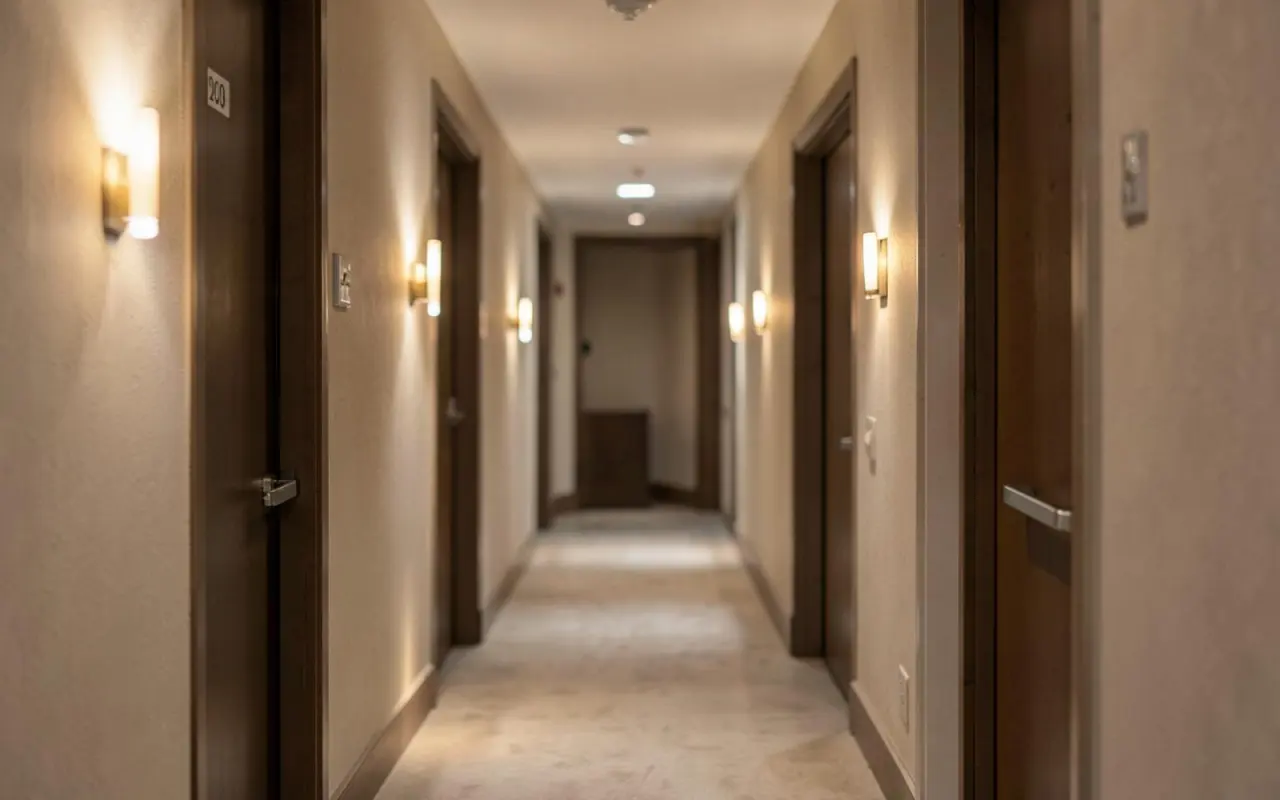
    Bedroom door condition is the finding we raise most often in hotels. Doors get damaged by luggage and trolleys, intumescent strips get painted over, self-closers are adjusted to stop slamming and no longer latch, and refurbishment introduces new locks and viewers that break certification. We inspect a meaningful sample rather than a token one, record each door by number, and photograph defects so maintenance can act without a second survey. Corridor protection is checked at the same time: ceiling voids, service penetrations, cupboards opening into escape routes and any furniture or artwork adding fire load.

    • Bedroom doors sampled and recorded by room number with photographic evidence
    • Intumescent and smoke seals checked for paint, damage and continuity
    • Self-closers checked for full closure and latching from any open angle
    • Corridor and stair enclosure checked including voids and service penetrations
    • Final exits and external escape routes checked for locking and obstruction

    Alarm category and detection coverage

    Sleeping accommodation normally requires an L1 or L2 system to BS 5839-1 depending on the building and the strategy, with detection in bedrooms as well as escape routes. We check the installed category against what is actually needed, look at whether zoning lets night staff identify the origin quickly, and check the maintenance and weekly test records. In smaller guest houses we frequently find a system installed at the right category originally but degraded by years of head replacements and additions that no longer match any design document.

    Kitchens, bars and cellars

    Most hotel fires start below the bedrooms. Commercial kitchen extract ducting is the classic: grease accumulation in a duct that runs through the building, often with cleaning records that cover the canopy but not the ductwork above it. We assess deep-clean frequency and evidence, suppression provision over fryers and ranges, gas isolation and interlock, cellar risks including gas cylinders and dispense systems, and the fire separation between all of that and the accommodation above. Where we find something serious, you get told on the day rather than in a report a week later.

    Night staffing and guest instruction

    The assessment has to establish what actually happens at night: how many staff are on, whether they are trained to investigate an alarm, how long they have before evacuation begins, and how guests with mobility needs are identified at check-in. We also check guest-facing information — the notice behind the door, the check-in briefing, and whether staff know how to assist someone who cannot use stairs. Serviced apartments and aparthotels with no staff on site at night need a different approach again, and we set out what that looks like.

    Serviced apartments and aparthotels

    Unstaffed serviced accommodation is a growing category and a genuinely awkward one, because it looks residential but functions as sleeping accommodation for people who have never been in the building before. Simultaneous evacuation is almost always the right strategy, which puts weight on the alarm system, on unambiguous signage, and on the information given at digital check-in. Where these units sit within a residential block, the assessment also has to address the interface with the block's own stay-put strategy — a conflict that catches out a lot of operators.

    What it costs

    A small guest house or boutique property up to around 15 rooms is typically £349 to £549. Mid-size hotels of 15 to 60 rooms are usually £549 to £999, and larger properties with conference space, multiple kitchens and back-of-house plant are quoted on floor area and complexity. Groups and management companies get programme pricing across the estate. Surveys can run out of hours at no extra cost where that suits your occupancy.


    Scope and price

    What it costs and how it runs.

    Indicative bands, confirmed as a fixed price before we book anything in.

    Indicative prices

    PropertyTypical scopePrice from
    Guest house, up to 15 roomsFull assessment including kitchen£349–£549
    Hotel, 15–60 roomsAssessment, door sample, back of house£549–£999
    Hotel, 60+ roomsFull property including conference and plantFrom £999
    Serviced apartments / aparthotelAssessment with unstaffed evacuation strategy£449–£899
    Group programmeScheduled assessments across the estateUp to 15% off per property
    Bands only — every building is priced on floors, units and complexity.

    From enquiry to report

    1. Scope agreedDay 1

      Room count, kitchens, staffing model and preferred survey window fixed.

    2. Survey3–8 hours

      Front and back of house, bedroom door sample, kitchen and plant.

    3. Verbal briefSame day

      Anything serious raised with the duty manager before we leave.

    4. ReportWithin 24 hours

      PAS 79 report, banded actions, door schedule with photographs.

    5. Re-inspectionWhen ready

      Optional check that remedial work has genuinely closed the findings.

    The difference

    Us versus a typical assessment.

    Most of the reports we are asked to review were produced remotely, from a template, by someone who never saw the building.
    Comparison between Fire Risk Specialists and a typical commodity fire risk assessment for Hotels & hospitality
    AspectFire Risk SpecialistsTypical assessment
    Bedroom doorsMeaningful sample, recorded by room, photographedA general comment on door condition
    Kitchen extractDuctwork cleaning evidence and suppression assessedCanopy noted as clean
    Alarm categoryInstalled category compared with BS 5839-1 requirementService certificate accepted at face value
    Night modelStaffing and investigation time tested against the strategyNot covered
    Survey timingOut of hours at no extra costDaytime only
    Urgent findingsRaised with the duty manager on the dayFirst seen in the report

    Instant estimate

    What it will cost.

    The same price bands our assessors quote from. Move the property count for portfolio pricing — from two properties upwards the rate drops.
    1. What kind of property?
    2. Type of premises
    6,000sq ft
    200 sq ft16,000 sq ft
    • Smallup to 1,600 sq ft
    • Medium1,600–5,400 sq ft
    • Large5,400+ sq ft

    1 property

    Your estimate

    £611–£811

    Large — 5,400+ sq ft · excluding VAT

    • Written report to British Standards PAS 79, within 24 hours of the visit.
    • Priced on floors, units and complexity — never on a call-out clock.
    • Fixed price confirmed in writing before we book the survey.
    020 3951 4856

    Estimates are guide bands, not a quotation. Unusual layouts, sprinklers, plant rooms or heritage fabric can move the figure either way.

    Before you book

    The honest answers.

    The six things people ask us before instructing — answered without the sales pitch.

    I have been quoted less elsewhere.

    Cheaper quotes are usually desktop reviews or template reports written without a site visit. Ours starts at £99 and always includes an assessor physically walking the building. If you have a cheaper written quote for the same scope, send it over and we will tell you honestly whether it covers you.

    I need it this week.

    Most visits are booked within a few working days and the written report follows within 24 hours of the assessor leaving site. If you have a licensing deadline, an insurer or a fire service inspection date, tell us the date when you enquire and we will work to it.

    How do I know the assessor is competent?

    Every assessment is carried out by an IFSM-registered assessor listed on the National Fire Risk Assessor Register — ours is ID 1576. Competence is exactly what an enforcing authority asks about first, and it is the one thing a cheap report cannot evidence.

    Will the report actually be usable?

    It is written in plain English to British Standards PAS 79, with every finding tied to the duty it satisfies and a prioritised action plan you can hand to a contractor or a managing agent without translation.

    I have more than one building.

    Portfolios are what we do most. One visit schedule, one reporting format, one renewal calendar, and pricing that drops from the second property onwards.

    What if something is found?

    Findings are ranked so you know what has to happen now, what can be planned, and what is advisory. We do not inflate a report to sell remedial work — and we will talk you through the actions on the phone at no cost.

    How it works

    From enquiry to compliant.

    1. 01

      Quote

      Priced in minutes, online or over the phone.

    2. 02

      Book

      Survey slots within days, same-day when urgent.

    3. 03

      Assess

      An in-house assessor attends and inspects in person.

    4. 04

      Report

      PAS 79 report and prioritised actions in 24 hours.

    The assessor behind the report

    Fire safety, run by an actual human

    Every hotels & hospitality instruction is carried out in person by an IFSM-registered assessor — never passed to a subcontractor.

    IFSM Registered

    Institution of Fire Safety Managers

    NFRAR ID 1576

    National Fire Risk Assessor Register

    1,000+ Assessments

    Across London and the South East

    Awais Sarwar

    Founder & Managing Director

    About Awais
    Awais Sarwar, Founder and Managing Director of Fire Risk Specialists

    Trusted by the teams we work for across London

    Audi
    Kia
    Car Giant
    GB News
    Budgens
    Pepe's Piri Piri
    Chicking
    Chaiwalla
    Zoomo
    Northwood
    Audi
    Kia
    Car Giant
    GB News
    Budgens
    Pepe's Piri Piri
    Chicking
    Chaiwalla
    Zoomo
    Northwood

    Frequently asked questions

    More from us

    Related services.

    Areas we cover

    All 32 London boroughs, plus Essex, Kent, Surrey and Hertfordshire.

    Book your hotels & hospitality from £349.

    Tell us about the building and we will price it in minutes. In-house IFSM-registered assessors, PAS 79 report within 24 hours of the visit.
    020 3951 4856

    No obligation. We answer the same day.

    Last word

    Ready when you are.

    Quote in 60 seconds. Assessor on site this week. Compliant report in your inbox within 24 hours. That's the whole process.

    020 3951 4856
    Transparent pricing No obligation 1,000+ assessments 100% compliance guarantee
    Awais Sarwar
    — Awais Sarwar, MSc
    MD · 4.9 Google
    4.9 rated
    ·1,000+ done·
    Guaranteed
    Call