





Do holiday lets need a fire risk assessment?
They do, and the position hardened considerably on 1 October 2023. The Regulatory Reform (Fire Safety) Order 2005 has always applied to premises used for paying guests — a holiday cottage, a self-catering apartment, a room let through a platform — because letting to the public is a business activity carried out in premises the law calls non-domestic. What changed under the amendments made by the Building Safety Act 2022 is that the old exemption allowing very small premises to hold an unwritten assessment was removed. Every responsible person must now record the significant findings of their fire risk assessment in writing, together with the fire safety arrangements, whether the property sleeps twelve or two. If you take money for people to sleep in a building you control, you need a written assessment and you need to be able to produce it.
- Self-catering cottages, barns, annexes and lodges
- Whole-property Airbnb, Booking.com and Vrbo listings
- Serviced apartments and aparthotels
- Rooms let in a property the host also occupies
- Glamping units, shepherd's huts and static caravans used for paying guests
- Corporate and contractor short stays
Does Airbnb require a fire risk assessment?
Airbnb itself does not police fire safety, and this is where a lot of hosts come unstuck. The platform asks hosts to confirm which safety devices are present and encourages compliance with local law, but it does not inspect anything, does not hold your assessment, and does not defend you if something goes wrong. The legal duty is the same whether you list on Airbnb, advertise in a shop window, or take bookings by phone: it sits with you as the responsible person, and it is enforced by the local fire and rescue authority, not by the platform. Insurers, on the other hand, increasingly do ask. A short-term let policy or a host protection endorsement generally assumes a compliant property, and a claim following a fire is exactly the moment somebody will ask to see the assessment.
Why a holiday let is genuinely different from a home
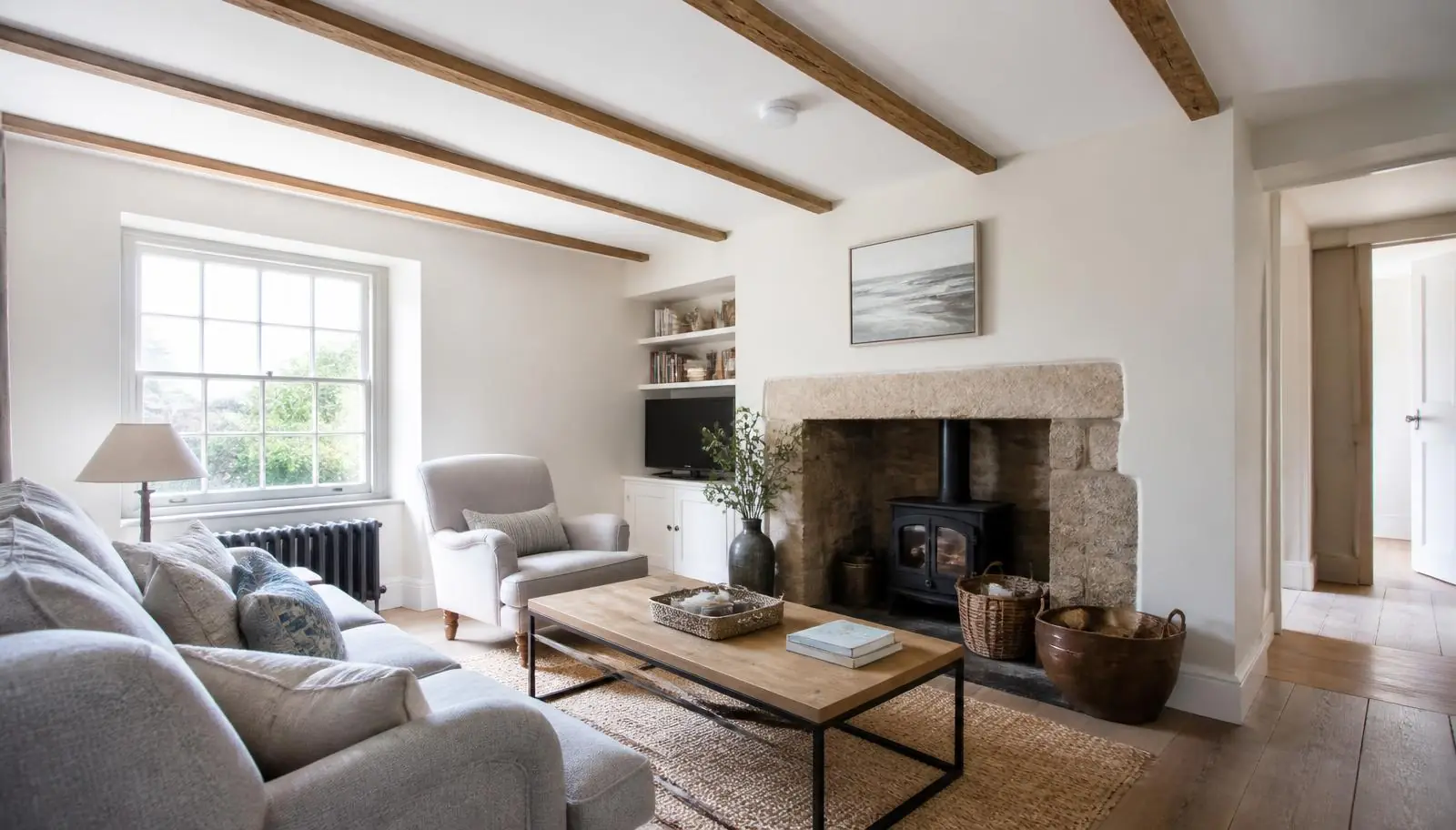
The building might be identical to the house next door. The people in it are not. A guest has never been in the property before, does not know that the back door sticks or that the stairs turn sharply at the top, is frequently asleep within hours of arriving, and may be a family with young children, an older group, or people who have been drinking. They will not have read a manual. In a fire at three in the morning, everything depends on whether the alarm wakes them, whether the route out is obvious in the dark and free of obstruction, and whether the front door opens without hunting for a key. That is what our assessors are testing for: not whether a competent adult who knows the building could get out, but whether a stranger, half asleep, could. It is also why we care so much about key-operated locks, unusual layouts, inner rooms, wood burners, hot tubs, barbecue storage, and where the phone charging happens.
What the assessment covers
The survey follows the PAS 79 methodology and is scaled to the property. For a two-bedroom cottage it takes around 45 minutes to an hour; for a large group-accommodation property with multiple floors and an escape stair it takes considerably longer. The assessor works through the building systematically and photographs everything that appears in the report.
- Escape routes from every bedroom, including inner rooms and loft conversions
- Whether final exit doors open from the inside without a key at all times
- Smoke and heat alarm coverage, grade, interlinking and position
- Carbon monoxide alarms where there is any combustion appliance
- Wood burners, open fires, hearths, flues and their maintenance records
- Kitchen risk, extraction, and the position of the alarm relative to cooking
- Electrical condition, extension leads, and where guests will charge devices
- Fire blanket, extinguisher provision and whether it is proportionate
- External risks: hot tubs, barbecue and fuel storage, bin positions, thatch
- Guest information: what they are told on arrival and how they are told it
What we most often find in holiday lets
The failures repeat, and almost all of them are cheap to fix. The most common by a distance is a thumb-turn missing from the final exit door — a key-operated lock on a door guests are expected to escape through, with the key kept in a drawer or on a hook the guest has never been shown. Next is alarm coverage that was correct for a family home but is not adequate for paying guests: a single battery alarm in the hall, nothing on the upper landing, nothing interlinked, so an alarm downstairs never wakes anybody upstairs. Then inner rooms — a bedroom whose only escape route runs through a living room with the wood burner in it. After that: no carbon monoxide alarm anywhere near the log burner; a fire blanket in a cupboard rather than by the hob; and fire safety information for guests that exists only in a welcome folder nobody opens. None of these require building work. They require somebody who knows to look for them.
The guest fire action notice
Every assessment we carry out on a short-stay property comes with a printable fire action notice written for that specific building — the escape route, where the alarms are, where to assemble, what to do about the wood burner, and the emergency numbers. Guests do not read welcome folders. They do glance at a framed notice by the door, and an enforcing officer or an insurer looks for one immediately. It costs us nothing to produce because we have already walked the building, and it is the single cheapest improvement most hosts make.
Where you let changes what applies
The fire safety duty is the same across England, but the surrounding rules are not. In London, letting a whole home on a short-term basis for more than 90 nights in a calendar year requires planning permission under the Deregulation Act 2015, and some boroughs enforce it actively. Elsewhere, a property let to several unrelated people at once may fall into HMO territory rather than holiday-let territory, which brings licensing and a different standard of fire precautions. Wales and Scotland operate their own licensing schemes with their own safety evidence requirements. We assess to the Fire Safety Order and tell you plainly where we think another regime is in play, so you are not discovering it from a council letter.
What it costs and how quickly we can come
Assessments start at £99 and are priced on the size and complexity of the property — bedrooms, floors, whether there is a combustion appliance, whether it is a single unit or one of several. There is no travel charge inside the M25 and no urgency premium for a working-hours visit. Turnaround is normally within a few working days, with same-day and next-day slots available where a booking, an insurer or a council enquiry has created a deadline. Multi-property hosts and management companies get a per-unit rate and a single renewal calendar, so the whole portfolio comes round on one date rather than arriving one letter at a time.