A Personal Emergency Evacuation Plan (PEEP) is an individually tailored plan for someone who may need support to escape a building in a fire, because of a disability, mobility impairment, sensory loss, cognitive condition or other factor. It sets out how that person will be alerted, what equipment or assistance they need, and their planned escape route. In residential settings, a residential PEEP (or the more recent person-centred fire risk assessment approach) covers similar ground for people who cannot self-evacuate a flat unaided.
Standard fire evacuation planning generally assumes that anyone who hears an alarm, or is aware smoke or fire has started, can act on that information and move independently to a place of safety. That assumption does not hold for everyone: someone using a wheelchair, someone with a significant visual or hearing impairment, someone with a cognitive condition such as dementia, or someone whose mobility is temporarily reduced (recovering from surgery, for example) may need a workplace or building to plan specifically for them, rather than being expected to fit a generic evacuation plan designed around the majority of occupants. A PEEP is that individual plan, developed with the person concerned rather than imposed on them.
Who needs a PEEP
PEEPs are most established in workplaces and premises where an employer, or a landlord in mixed-use or supported settings, has a relationship with a specific known individual, and are required in effect through the Fire Safety Order's duty to consider people especially at risk. They are relevant wherever any of the following apply to an identified occupant.
Mobility impairments affecting the ability to use stairs unaided, particularly relevant in multi-storey buildings without an evacuation lift.
Sensory impairments (visual or hearing) that could prevent someone becoming aware of an alarm or wayfinding signage.
Cognitive or mental health conditions that could affect someone's ability to understand or act on evacuation instructions in an emergency.
Temporary conditions such as recent injury, surgery, or late-stage pregnancy that reduce mobility for a defined period.
Anyone who has told the responsible person they would need assistance to evacuate, regardless of whether a formal diagnosis or disclosure of disability has been made.
What a PEEP should contain
A PEEP is short, specific and person-centred, not a generic form filled in the same way for everyone. It should be developed in discussion with the individual concerned, reviewed periodically, and shared with anyone who would need to act on it in an emergency.
How the person will be alerted to a fire — visual alerting for someone with a hearing impairment, for example, rather than relying on an audible alarm alone.
The specific escape route the person will use, including any part of it that may need to be kept clear or modified (avoiding an unramped step, for example).
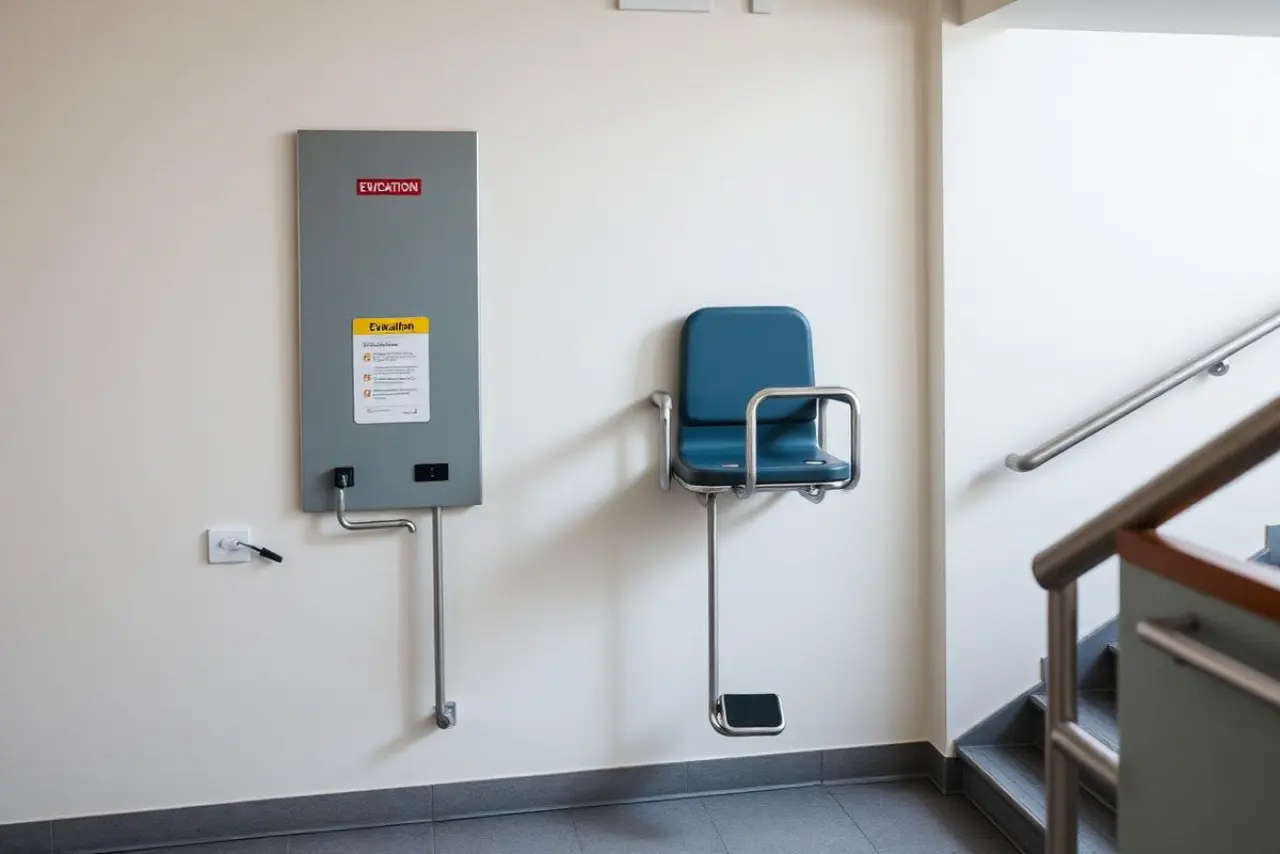
Any equipment required, such as an evacuation chair for stairs, and who is trained and available to operate it.
Who is responsible for assisting the person — named individuals (a buddy or fire warden), not simply 'staff' or 'someone'.
What happens if the identified helper is not present when the alarm sounds, including a fallback arrangement.
A horizontal or 'defend in place' contingency if full evacuation to the outside is genuinely not achievable in the time available, and how the location of anyone sheltering in place is communicated to the fire and rescue service.
PEEP content checklist
Alerting method confirmed for the individual's sensory needs
Specific escape route documented, including any obstacles
Equipment identified (e.g. evacuation chair) and named trained operators
Named assisting individual(s), not a generic role
Fallback arrangement if the named helper is absent
Defend-in-place contingency and how it is communicated to attending crews
The buildings behind this advice
Residential PEEPs and the stay-put problem
In a workplace, a PEEP is relatively straightforward because there is a defined employer, defined shift patterns and trained fire wardens on site. In residential blocks — particularly those built on a stay-put strategy — a residential PEEP is much harder to deliver in the same form, because there is no equivalent workforce on site around the clock to physically assist someone, and a stay-put strategy specifically depends on most residents not evacuating at all unless directly affected. Following Grenfell, government guidance moved away from expecting a fully resourced 'PEEP' for every resident who might need one in every residential building, toward a person-centred fire risk assessment approach, sometimes described through the Personal Emergency Evacuation Information (PEEI) concept, which records what a resident's needs are and what could realistically be done, without creating an unfunded assumption that staff will physically carry someone down a stairwell.
How PEEPs interact with the building's overall strategy
A PEEP must be consistent with, not contradictory to, the building's overall evacuation strategy. In a simultaneous evacuation building, the PEEP should set out how the identified person gets out alongside everyone else in the same timeframe. In a stay-put building, the PEEP needs to address the harder question of what happens if a fire does occur in or spreads to that specific person's flat, since stay-put assumes the person can remain safely in place unless directly affected — which is exactly the scenario a PEEP exists to plan for. This is also why residential PEEPs increasingly focus on ensuring evacuation lifts, refuge points, and clear communication to the fire and rescue service (through the building's information box, where over 18 metres) about where assistance may be needed, rather than solely on staff-assisted physical evacuation.
Recording, reviewing and communicating PEEPs
A PEEP is only useful if the people who would act on it in an emergency actually know it exists. Store it accessibly (while respecting the individual's confidentiality and data protection rights), share the operational content with fire wardens, building management and, in higher-risk buildings, make relevant details available to the fire and rescue service through pre-planning visits or the building's information box. Review the PEEP whenever the person's circumstances change, whenever the building or its evacuation strategy changes, and at a set periodic interval regardless, since needs and building conditions both drift over time.
Data protection and consent
A PEEP inevitably contains sensitive personal information — details of a disability or health condition fall within special category data under UK GDPR — so it must be collected and stored with the individual's informed consent and limited to those who genuinely need it to help in an emergency. In practice this means the full clinical or personal detail sits with the responsible person or managing agent under appropriate data protection controls, while a shorter operational summary (alerting method, route, equipment, named helper) is shared with fire wardens or on-site staff who would actually act on it during an incident. Getting this balance wrong in either direction is a real problem: over-sharing breaches the person's privacy, while under-sharing leaves the people expected to help without the information they need at the moment it matters.
PEEPs in HMOs and shared housing
HMOs present their own version of the residential PEEP challenge, because turnover of tenants is often higher and there is rarely dedicated on-site staff at all, so the landlord or managing agent has to build a realistic process for identifying a new tenant's needs at move-in, recording them proportionately, and making sure fellow residents or a nominated contact know what to do if that person needs assistance. This should be built into the standard move-in process rather than treated as an afterthought only considered after an incident, and reviewed again whenever a tenant's circumstances or the property itself changes.
Getting PEEPs into the fire risk assessment properly
The fire risk assessment should explicitly record how people especially at risk are identified in the building, what plans (PEEPs, PEEIs or equivalent) exist for named individuals, and how those plans are consistent with the stated evacuation strategy — not simply note in general terms that 'vulnerable residents will be considered'. Where a responsible person cannot demonstrate any process for identifying such residents at all, that is itself a finding an assessor should raise, because a process that only starts once someone happens to mention a need is not a suitable and sufficient assessment of risk to that person.
Evacuation lifts and refuge points
Physical infrastructure matters as much as paperwork when it comes to actually delivering what a PEEP or PEEI promises, and two features come up repeatedly in our work with taller residential and commercial buildings: evacuation lifts and refuge points. An evacuation lift is a lift specifically designed, powered and protected to remain operable during a fire and to be used, under fire service or trained personnel control, to move people who cannot use the stairs; an ordinary passenger lift is not a substitute, since standard lifts are typically recalled to the ground floor and taken out of service automatically in a fire. A refuge point is a protected space, usually a fire-resisting lobby or stairway landing, where someone can wait safely, out of the direct path of fire and smoke, for either an evacuation lift or assisted evacuation to arrive. Any PEEP or building-wide PEEI arrangement relying on either feature should confirm it actually exists, is correctly maintained, and that the specific person's flat or workspace has practical access to it — a refuge point three floors away is not a realistic plan for someone who cannot manage stairs at all.
Confirm any lift relied upon in a PEEP is a genuine evacuation lift, not a standard passenger lift that will be recalled and disabled in a fire.
Check refuge points are genuinely accessible from the specific flat or workspace in question, not merely present somewhere in the building.
Test call systems at refuge points regularly, since a refuge point with a non-functioning way of signalling for help is of limited practical use.
Record refuge point locations and evacuation lift availability clearly within the PEEP itself, not only in a separate building management document.
Training staff and fire wardens to act on PEEPs
A PEEP is a plan on paper until someone actually carries it out, so the people named within it — fire wardens, on-site staff, a nominated neighbour in a residential setting — need to know their role well before an emergency, not learn it for the first time when an alarm sounds. This means practical training on any equipment named in the plan, such as an evacuation chair, refresher sessions at a sensible interval so skills and confidence do not lapse, and a clear, rehearsed answer to what happens if the named helper is off site, on leave, or simply not immediately available when the alarm goes off. Fire drills in workplaces and, where practical, awareness exercises in residential settings should specifically test whether the PEEP arrangements work in practice, not just whether the general evacuation goes smoothly for everyone else.