





Fire RiskSpecialists

    Serviced & corporate stays

    Short-term let fire risk assessment from £99

    Fire risk assessments for short-term lets, serviced apartments and corporate stays. Per-unit portfolio pricing, PAS 79 reports in 24 hours. From £99 per unit.
    IFSM registeredNFRAR listed24-hour reports£5M insured
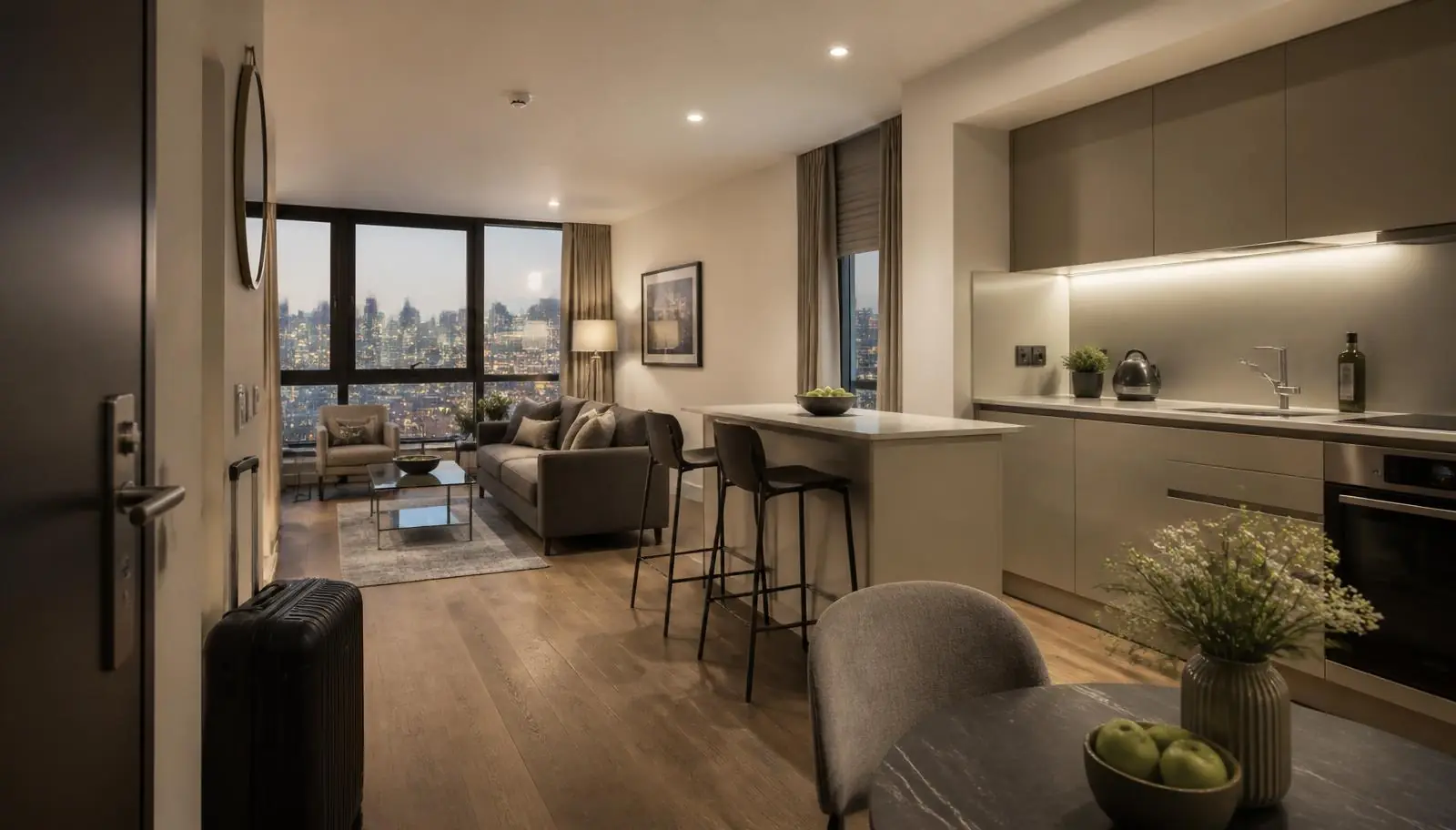
    Modern London serviced apartment with open-plan kitchen, luggage by the door and city view at dusk
    AudiKiaGB NewsBudgens
    The short answer

    A short-term let fire risk assessment is a written PAS 79 assessment of a property let for stays of days or weeks — a serviced apartment, a corporate let, an aparthotel unit or a short-stay flat inside a managed block. It is a legal requirement under the Fire Safety Order for every such unit, recorded in writing since October 2023. Fire Risk Specialists assess short-stay portfolios on a per-unit rate from £99, with reports issued within 24 hours and every property on a single renewal calendar.

    020 3951 4856

    £99

    Starting price, all inclusive

    24hr

    Written PAS 79 report

    1,000+

    Buildings assessed

    £5M

    Public liability insurance

    Per unit from

    £99

    Falls with portfolio volume

    Report

    24 hours

    Same format across every unit

    Review

    Annually

    Or on material change of use

    Renewals

    One calendar

    We chase you, not the reverse

    What you get

    Everything included, nothing subcontracted.

    What is covered as standard on every assessment we carry out.

    Priced per unit, not per visit

    Operators with multiple units get a per-unit rate that falls with volume, and one invoice rather than one per property.

    One renewal calendar

    Every unit sits on a single schedule with reminders, so nothing lapses quietly between letting agents and cleaners.

    The block is looked at too

    Where your unit sits inside a managed block, we tell you what the freeholder is responsible for and what you cannot fix yourself.

    Consistent reporting

    Every unit reported in the same format, so a corporate client, insurer or licensing officer can compare them at a glance.

    What counts as a short-term let

    For fire safety purposes the label on the listing matters far less than the arrangement underneath it. If people pay to sleep in a property for a short period and it is not their home, the Fire Safety Order applies and the assessment must be written down. That captures serviced apartments and aparthotels, corporate lets for relocating staff, contractor accommodation, insurance and displacement housing, medical-stay accommodation near hospitals, and the growing category of residential flats operated commercially for short stays. It also captures the awkward middle ground — a flat let on rolling 28-day bookings, or a unit that is a short-stay let in summer and an assured shorthold tenancy in winter. Where the use changes across the year, the assessment needs to cover the riskier use, and we say so explicitly in the report.

    • Serviced apartments and aparthotel units
    • Corporate lets and relocation accommodation
    • Contractor and project accommodation
    • Insurance, displacement and temporary housing
    • Medical and hospital-adjacent stays
    • Residential flats operated commercially for short stays

    When your unit sits inside somebody else's block

    This is the single most misunderstood situation in the sector, and it produces most of the arguments. If you operate a short-stay flat inside a purpose-built block, there are two assessments in play, not one. The freeholder or managing agent is the responsible person for the common parts — the stairs, the corridors, the communal alarm and lighting, the flat entrance doors as they affect the escape route. You are the responsible person for the way your unit is used, occupied and equipped. Neither party can discharge the other's duty. In practice what goes wrong is that operators assume the block assessment covers them and hold nothing at all, while the managing agent has never been told the flat is being let on short stays and has assessed the building on a stay-put basis that assumes residents who know it. Our assessment for you covers your unit properly, records what we can see of the communal provision, and sets out plainly what to raise with the freeholder — including whether your lease and the block's insurance actually permit short-stay use, which is worth knowing before an enforcement officer asks.

    How a portfolio programme works

    Assessing twenty units one at a time, each with its own quote, its own report format and its own renewal date, is how portfolios end up with gaps. A programme replaces that with one arrangement. We survey in geographic clusters so travel is efficient and the rate reflects it, report every unit in the same format with the same risk banding, and give you a single register showing every property, its assessment date, its renewal date and its open actions. Renewals are diarised and we chase you rather than waiting to be remembered. Where your units are similar — a repeated apartment layout across a building or a scheme — we still survey each one, because the failures we find are almost always about how a specific unit is equipped and used rather than its floor plan, but the reporting overhead comes down and the price with it.

    What the assessment covers in a short-stay unit

    The survey follows PAS 79 and is scaled to the unit, typically taking 30 to 60 minutes for an apartment.

    • Escape route from the unit and into the building's protected route
    • The flat entrance door: self-closer, seals, glazing, condition and rating
    • Detection within the unit, its grade and whether it is interlinked
    • How the unit's occupants would be alerted if the fire started elsewhere
    • Whether the building's evacuation strategy suits guests who do not know it
    • Kitchen risk, extraction and appliance condition in a high-turnover unit
    • Electrical safety, charging arrangements and any e-bike or scooter storage
    • Housekeeping, linen and consumable storage, and cleaner access arrangements
    • Key safes, smart locks and whether the exit works in a power cut
    • The information given to guests and how it reaches them

    Smart locks, key safes and getting out

    The operational model that makes short-stay lettings work — remote check-in, key safes, smart locks, no staff on site — introduces risks a conventional assessment never had to consider. We look hard at three of them. First, whether every door on the escape route opens from the inside without a key, a code, an app or a charged phone, in the dark, by somebody who arrived four hours ago. Second, what happens in a power cut or a dead battery, because a smart lock that fails secure is a locked exit. Third, whether anybody would know a guest was in the building at all: with no reception and no staff, an evacuation depends entirely on detection and on the guest understanding, from the notice in front of them, what to do. None of this makes remote operation wrong. It makes the detail matter more.

    What operators are usually asked for

    Corporate clients booking staff accommodation increasingly run a supplier questionnaire, and fire safety evidence is on it. Insurers ask at renewal. Local authorities ask when a complaint arrives or when planning use is queried, and in London the 90-night rule under the Deregulation Act 2015 gives them a reason to look. Booking platforms and agencies handling corporate contracts sometimes ask before they will list you. What satisfies all of them is the same thing: a current written assessment per unit, by a named assessor whose registration can be checked, with a prioritised action plan showing what has been closed out. What does not satisfy them is a single assessment of one flat being offered as evidence for eleven.

    Cost, timing and coverage

    Single units start at £99 and portfolios are priced per unit, with the rate falling as volume rises and units cluster geographically. There is no travel charge inside the M25 and we cover Essex, Kent, Surrey and Hertfordshire as standard. Turnaround for reports is 24 hours from survey, and surveys are scheduled around your occupancy — most operators give us a window between bookings and we work through a building in a day. Where a corporate deadline or an insurance renewal is driving the timing, say so at the outset and we will work backwards from the date.


    Scope and price

    What it costs and how it runs.

    Indicative bands, confirmed as a fixed price before we book anything in.

    Indicative prices

    PropertyTypical scopePrice from
    Single serviced apartmentUnit assessment and report£99–£199
    Two to five unitsPer unit, surveyed in one visit£95–£159 each
    Six to twenty unitsProgramme, one register and calendar£89–£139 each
    Twenty units and aboveRolling annual programmeFrom £79 each
    Communal parts of a block you controlPAS 79 Type 1 assessment£249–£549
    Bands only — every building is priced on floors, units and complexity.

    From enquiry to report

    1. ScopeSame day

      Unit list, addresses and access arrangements. Priced per unit.

    2. Schedule2–5 days

      Units grouped geographically and booked around occupancy.

    3. Survey30–60 mins each

      Each unit surveyed individually by an IFSM-registered assessor.

    4. Reports24 hours

      One report per unit, identical format, plus a portfolio register.

    5. RenewalsOngoing

      Diarised annually with reminders before anything lapses.

    The difference

    Us versus a typical assessment.

    Most of the reports we are asked to review were produced remotely, from a template, by someone who never saw the building.
    Comparison between Fire Risk Specialists and a typical commodity fire risk assessment for Short-term lets
    AspectFire Risk SpecialistsTypical assessment
    PricingPer unit, falling with volume, one invoiceFull price per property, priced as unrelated jobs
    The block above youCommunal provision reviewed and the freeholder's duties spelled outUnit assessed in isolation, block never mentioned
    ConsistencyIdentical format and risk banding across every unitDifferent assessors, different templates, no comparability
    RenewalsOne calendar with reminders we send youYou remember, or you don't
    Remote-operation riskSmart locks, key safes and power failure assessed explicitlyNot considered

    How fast

    How quickly we can get to you.

    Standard bookings in London are attended within two to five working days. When you have a deadline, this is what happens instead.

    Today

    Same-day survey where we can

    We hold short-notice capacity across London every working day. Call and you get a straight yes or no for your postcode on that call, not a maybe.

    Within 24 hours

    Urgent instructions attended

    Deadline work — a notice, a licence, an insurance renewal, a stalled sale — is placed ahead of the routine diary rather than queued behind it.

    24 hours after the survey

    Written PAS 79 report

    Written by the assessor who attended, with photographs and a prioritised action plan. Anything urgent is raised on site, not held back for the document.

    Same-day attendance depends on assessor availability, the size of the building and access being arranged. We tell you honestly on the call whether today is possible.

    Instant estimate

    What it will cost.

    The same price bands our assessors quote from. Move the property count for portfolio pricing — from two properties upwards the rate drops.
    1. What kind of property?
    2. Which best describes it?

    3 properties — portfolio discount of 5% applied

    Your estimate

    £425–£995

    2-Storey Communal × 3 · excluding VAT

    • Written report to British Standards PAS 79, within 24 hours of the visit.
    • Priced on floors, units and complexity — never on a call-out clock.
    • Fixed price confirmed in writing before we book the survey.
    020 3951 4856

    Estimates are guide bands, not a quotation. Unusual layouts, sprinklers, plant rooms or heritage fabric can move the figure either way.

    Before you book

    The honest answers.

    The six things people ask us before instructing — answered without the sales pitch.

    I have been quoted less elsewhere.

    Cheaper quotes are usually desktop reviews or template reports written without a site visit. Ours starts at £99 and always includes an assessor physically walking the building. If you have a cheaper written quote for the same scope, send it over and we will tell you honestly whether it covers you.

    I need it this week.

    Most visits are booked within a few working days and the written report follows within 24 hours of the assessor leaving site. If you have a licensing deadline, an insurer or a fire service inspection date, tell us the date when you enquire and we will work to it.

    How do I know the assessor is competent?

    Every assessment is carried out by an IFSM-registered assessor listed on the National Fire Risk Assessor Register — ours is ID 1576. Competence is exactly what an enforcing authority asks about first, and it is the one thing a cheap report cannot evidence.

    Will the report actually be usable?

    It is written in plain English to British Standards PAS 79, with every finding tied to the duty it satisfies and a prioritised action plan you can hand to a contractor or a managing agent without translation.

    I have more than one building.

    Portfolios are what we do most. One visit schedule, one reporting format, one renewal calendar, and pricing that drops from the second property onwards.

    What if something is found?

    Findings are ranked so you know what has to happen now, what can be planned, and what is advisory. We do not inflate a report to sell remedial work — and we will talk you through the actions on the phone at no cost.

    How it works

    From enquiry to compliant.

    1. 01

      Quote

      Priced in minutes, online or over the phone.

    2. 02

      Book

      Survey slots within days, same-day when urgent.

    3. 03

      Assess

      An in-house assessor attends and inspects in person.

    4. 04

      Report

      PAS 79 report and prioritised actions in 24 hours.

    The assessor behind the report

    Fire safety, run by an actual human

    Every short-term lets instruction is carried out in person by an IFSM-registered assessor — never passed to a subcontractor.

    IFSM Registered

    Institution of Fire Safety Managers

    NFRAR ID 1576

    National Fire Risk Assessor Register

    1,000+ Assessments

    Across London and the South East

    Awais Sarwar

    Founder & Managing Director

    About Awais
    Awais Sarwar, Founder and Managing Director of Fire Risk Specialists

    Trusted by the teams we work for across London

    Audi
    Kia
    Car Giant
    GB News
    Budgens
    Pepe's Piri Piri
    Chicking
    Chaiwalla
    Zoomo
    Northwood
    Audi
    Kia
    Car Giant
    GB News
    Budgens
    Pepe's Piri Piri
    Chicking
    Chaiwalla
    Zoomo
    Northwood

    Frequently asked questions

    More from us

    Related services.

    Areas we cover

    All 32 London boroughs, plus Essex, Kent, Surrey and Hertfordshire.

    Book your short-term lets from £99.

    Tell us about the building and we will price it in minutes. In-house IFSM-registered assessors, PAS 79 report within 24 hours of the visit.
    020 3951 4856

    No obligation. We answer the same day.

    Last word

    Ready when you are.

    Quote in 60 seconds. Assessor on site this week. Compliant report in your inbox within 24 hours. That's the whole process.

    020 3951 4856
    Transparent pricing No obligation 1,000+ assessments 100% compliance guarantee
    Awais Sarwar
    — Awais Sarwar, MSc
    MD · 4.9 Google
    4.9 rated
    ·1,000+ done·
    Guaranteed
    Call