





Fire RiskSpecialists

    Guide · guides

    E-bike and e-scooter battery fires: managing the risk in communal areas

    The fastest-growing cause of serious fires we see referenced in London residential blocks — and what a workable policy actually looks like.

    11 min readBy Nabhan Islam Reviewed by Awais Sarwar, MSc Updated 6 Sept 2026
    E-bike and e-scooter battery fires: managing the risk in communal areas
    AudiKiaGB NewsBudgens
    The short answer

    E-bike and e-scooter lithium-ion battery fires start and spread far faster than typical domestic fires, often reaching full involvement within minutes and releasing toxic gases, which is why London Fire Brigade and most fire risk assessors now treat charging and storage of these batteries in communal escape routes as a significant, specifically named hazard requiring its own written policy, not just a general housekeeping note. Managing the risk well means addressing both the prohibition on charging in escape routes and the practical alternative residents need instead.

    020 3951 4856

    Failure mode

    Thermal runaway

    can reach full fire in under a minute

    Reignition risk

    Hours after extinguishing

    damaged cells can reignite unexpectedly

    Higher-risk sources

    Second-hand batteries & conversion kits

    disproportionately linked to failures

    Disposal route

    Never general waste

    puncture risk during collection and processing

    Why this risk is different from a normal electrical fire

    A failing lithium-ion battery can enter thermal runaway — an uncontrollable, self-sustaining chemical reaction producing intense heat, flammable gas and often violent jetting flames, sometimes with little or no warning. Unlike a smouldering upholstery fire, which can take a long time to develop and gives occupants a reasonable window to notice and react, a battery in thermal runaway can go from normal operation to a fully involved fire in well under a minute, and can reignite hours later even after apparently being extinguished by the fire service. London Fire Brigade has repeatedly highlighted this as one of the fastest-growing causes of fires it attends, driven by the rapid growth in e-bike and e-scooter ownership and, particularly, second-hand and non-standard conversion kits and chargers bought online from unverified sellers. The intensity and speed of these fires, combined with the toxic smoke they generate, is why the response from fire risk assessors and managing agents has shifted quickly from treating this as a minor nuisance issue to treating it as a named, high-priority hazard in its own right.

    Why communal areas are the specific concern

    The risk itself exists wherever a battery is charged, but a fire that starts in a communal hallway, stairwell or bin store is far more dangerous than the same fire starting inside a single flat, because it can immediately compromise the only shared escape route for every other resident in the building. A fire inside one flat, behind a reasonably maintained fire door, is a contained problem for the neighbours; a fire in the stairwell itself is a problem for everyone above the fire.

    • Corridors and stairwells are the means of escape for the entire building, not just one household.
    • Communal areas often lack the compartmentation of an individual flat, allowing smoke and fire to spread faster.
    • Residents charging in hallways are frequently doing so precisely because they lack safe charging space in a small flat — the underlying cause needs addressing, not just the symptom.
    • Bin and cycle stores attached to or below residential accommodation can allow a battery fire to spread into the structure itself.
    • Multiple bikes stored together in a single store multiply the consequence of one battery failing, since a fire can spread bike to bike.

    What a workable written policy actually covers

    A notice telling residents 'do not charge e-bikes in the hallway' without more is rarely effective on its own, because it does not solve the underlying problem of where residents are supposed to charge instead. A genuinely workable policy addresses both the prohibition and the alternative, and is communicated clearly rather than left as a laminated sheet by the post boxes that nobody reads twice.

    • An explicit rule prohibiting charging of e-bikes, e-scooters and similar devices in communal corridors, stairwells, lobbies and other escape routes.
    • Guidance on safe charging within individual flats: not left unattended overnight, not charged on a bed or soft furnishing, using only the manufacturer's original charger.
    • Where possible, a designated, ventilated, fire-separated storage/charging area away from the main escape route, for buildings able to provide one.
    • A clear statement on batteries and conversion kits purchased second-hand or online from unverified sellers, which have a disproportionately high failure rate.
    • What residents should do if a battery is damaged, swollen, unusually hot, or was involved in a water-damage incident (which can trigger delayed failure).
    • How suspected faulty batteries or non-compliance should be reported, and to whom, with a named contact rather than a vague instruction to 'tell the office'.


    The buildings behind this advice

    AudiKiaGB NewsBudgensPepe's Piri PiriCar Giant

    Storage and disposal beyond charging

    The risk does not end when charging stops — damaged, swollen or end-of-life batteries stored anywhere in the building, including bin stores, present an ongoing hazard, and lithium-ion batteries must never go into general waste or standard recycling because of the risk of puncture during collection and processing. A punctured cell in a bin lorry compactor is a well-documented cause of vehicle and depot fires, quite separate from the risk inside the building itself.

    • Direct residents to dedicated battery take-back or recycling points rather than general waste.
    • Add clear signage to communal bin stores stating that damaged batteries are not general waste.
    • Treat any swollen, hot, or physically damaged battery as an immediate hazard, not something to store until convenient to dispose of.
    • Keep a record of any battery-related incidents or near-misses reported by residents or staff.

    How this shows up in a fire risk assessment

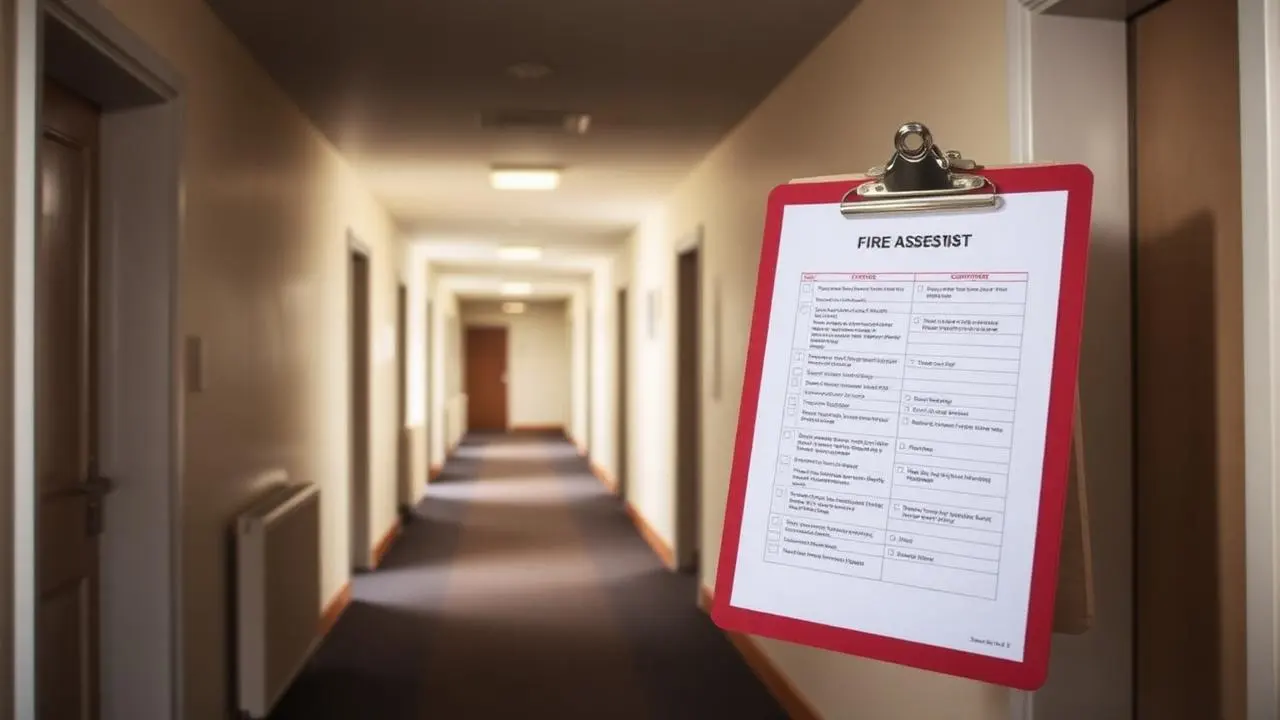
    Assessors now specifically ask about and record e-bike and e-scooter charging arrangements as a standalone line item, rather than folding it into a generic 'housekeeping' comment, reflecting how London Fire Brigade and most insurers now view the risk. On site, this means an assessor is actively looking for evidence of the behaviour, not just asking whether a policy exists on paper.

    • Is there evidence of e-bike/e-scooter charging in communal areas at the time of the visit (cables run under doors, bikes parked in stairwells)?
    • Is there a written policy communicated to residents, and is it actually being followed rather than just posted?
    • Is there any designated safe charging provision, and if so is it appropriately fire-separated from escape routes?
    • Has the building or managing agent had any reported incidents, near-misses or fire brigade attendances relating to batteries?
    • Are residents storing damaged or unused batteries anywhere in the common parts, including bin and cycle stores?
    ScenarioTypical findingRecommended action
    Bikes regularly parked in stairwellEscape route obstructed, charging cables trailingImmediate removal, written warning, alternative storage sought
    No written policy existsResidents unaware of the specific riskDraft and issue policy within one month
    Designated store exists but unventilatedFire and smoke risk concentrated in one spaceImprove ventilation and separation, review at next assessment
    Second-hand conversion kits reportedElevated failure risk from non-standard componentsCommunicate risk directly, encourage manufacturer-approved equipment
    Typical e-bike related findings recorded during a fire risk assessment and the follow-up action we would expect.

    What managing agents and freeholders can practically do now

    Even without capital works to create a dedicated charging area, several low-cost steps meaningfully reduce the risk: issuing a clear written policy to all residents, physically removing bikes and scooters found in escape routes with a documented process, working with residents to identify and support genuine alternative charging arrangements, and making sure the fire risk assessment explicitly covers this hazard so it is reviewed, not forgotten, at the next assessment. None of these require significant budget, and all of them are things a licensing officer or enforcing authority would expect to see evidence of if asked.

    Fire extinguishers and lithium-ion fires

    It is worth being clear with residents and staff that a standard water or foam extinguisher is unlikely to fully extinguish a lithium-ion battery fire, because the reaction can continue internally within the cell regardless of surface cooling. The standard advice from fire and rescue services is to evacuate rather than attempt to fight a battery fire directly, call 999 immediately, and warn others in the building — this is a different response to how most people are taught to react to a small kitchen fire, and it is worth stating explicitly in resident-facing guidance rather than assuming it is obvious.

    Working with leaseholders and residents rather than against them

    The most effective policies we see are developed with some input from residents rather than imposed purely top-down, because e-bikes and e-scooters are often a genuine transport necessity, particularly for delivery workers, and a policy perceived as punitive without an alternative tends to be quietly ignored. Consultation does not need to be extensive — even a short residents' notice explaining the reasoning, alongside the practical alternative, tends to achieve better long-term compliance than an enforcement-only approach. In our experience, buildings that involve a handful of residents in drafting the wording of the policy, rather than issuing it purely from the management office, tend to see faster and more durable compliance, because the residents most likely to push back have already had their concerns heard and, where reasonable, addressed before the policy is enforced against anyone.

    Insurance and buildings cover implications

    Buildings insurers have become noticeably more attentive to e-bike and e-scooter charging risk in communal areas over the past few years, and some now ask specific questions about it at renewal or when settling a claim connected to a fire of unknown or electrical origin. A managing agent who cannot demonstrate any written policy, any record of enforcement action, or any consideration of the risk in the current fire risk assessment may find this used against the building at renewal, in the form of increased premiums, additional policy conditions, or in the worst case a declined claim if an insurer can show the risk was known about and not addressed. This is a further practical reason, beyond the safety case itself, to treat the issue as a standing agenda item for the building rather than something raised once and then left.

    • Keep dated records of the policy being issued and reissued to residents, not just a single historic notice.
    • Record any enforcement action taken, including bikes removed from escape routes and the date this happened.
    • Note the hazard specifically in the fire risk assessment and any subsequent review, rather than relying on memory of a verbal conversation.
    • Ask the buildings insurer directly whether they have any specific requirements or preferred wording for an e-bike policy at the next renewal.

    New-build and refurbishment considerations

    Where a building is being newly constructed or substantially refurbished, this is the best opportunity to design out much of the underlying problem rather than relying on a policy to manage it after the fact. A dedicated, fire-separated and ventilated cycle and e-mobility store at ground or basement level, positioned away from the main escape route and ideally with its own detection and, where justified by scale, suppression, removes much of the pressure that otherwise pushes charging into corridors and stairwells. Developers and design teams increasingly treat this as a standard consideration alongside conventional cycle storage, reflecting both regulatory direction of travel and the practical reality that residents will charge devices somewhere, whether or not the building has planned for it.

    Written by

    Nabhan Islam

    Head of Marketing & Commercial Lead

    Reviewed by

    Awais Sarwar, MSc

    Fire Risk Assessor — IFSM-registered, National Fire Risk Assessor Register ID 1576

    11 min readLast reviewed 6 September 2026Facts verified 6 September 2026 Checked quarterly

    Sources

    1. Regulatory Reform (Fire Safety) Order 2005 legislation.gov.uk
    2. Fire safety risk assessment guidance GOV.UK (Home Office)
    3. E-bike and e-scooter battery safety Office for Product Safety and Standards
    4. London Fire Brigade fire safety guidance London Fire Brigade
    5. Fire and rescue incident statistics, England Home Office

    Was this page helpful?

    Frequently asked questions

    Call
    Last word

    Ready when you are.

    Quote in 60 seconds. Assessor on site this week. Compliant report in your inbox within 24 hours. That's the whole process.

    020 3951 4856
    Transparent pricing No obligation 1,000+ assessments 100% compliance guarantee
    Awais Sarwar
    — Awais Sarwar, MSc
    MD · 4.9 Google
    4.9 rated
    ·1,000+ done·
    Guaranteed
    Call