PAS 79 is a British Standards Institution Publicly Available Specification setting out a recommended methodology and reporting format for fire risk assessments (PAS 79-1) and historically for housing assessments (withdrawn PAS 79-2:2020; now BS 9792:2025). It is not itself a legal requirement, but it is the format enforcement officers, insurers and lenders expect a competent assessment to follow, and reports written against it are far more defensible than an ad hoc or purely narrative report.
PAS stands for Publicly Available Specification — a fast-tracked, industry-developed standard published by BSI, sitting a step below a full British Standard but developed through a similar consensus process involving fire safety professionals, enforcing authorities and industry bodies. PAS 79-1 covers general fire risk assessment methodology and reporting; PAS 79-2:2020 covered housing FRA and was later withdrawn; BS 9792:2025 is its revised conversion. Because a PAS is developed faster and with a narrower remit than a full British Standard, it can be updated more readily as practice evolves, which is one reason it has become the practical reference point in an area of law — the Fire Safety Order — that deliberately does not prescribe a rigid format itself.
Why it matters even though it is not mandatory
The Fire Safety Order requires a 'suitable and sufficient' assessment but does not itself mandate a specific report format. PAS 79 has become the de facto industry standard for what 'suitable and sufficient' looks like in practice, for a straightforward reason: it was developed jointly with fire and rescue services and reflects what they expect to see when they request evidence of compliance. A report that follows PAS 79 structure is far easier for an enforcement officer, an insurer's assessor, or a court to evaluate than an unstructured narrative document.
It gives enforcing authorities a consistent structure to check against, speeding up any audit or investigation.
It gives insurers a recognisable format when assessing risk at renewal or after a claim.
It gives lenders and conveyancing solicitors something concrete to point to for buildings with shared responsibility.
It reduces the chance that a genuinely significant finding gets lost in unstructured prose.
What a PAS 79-1 compliant report contains
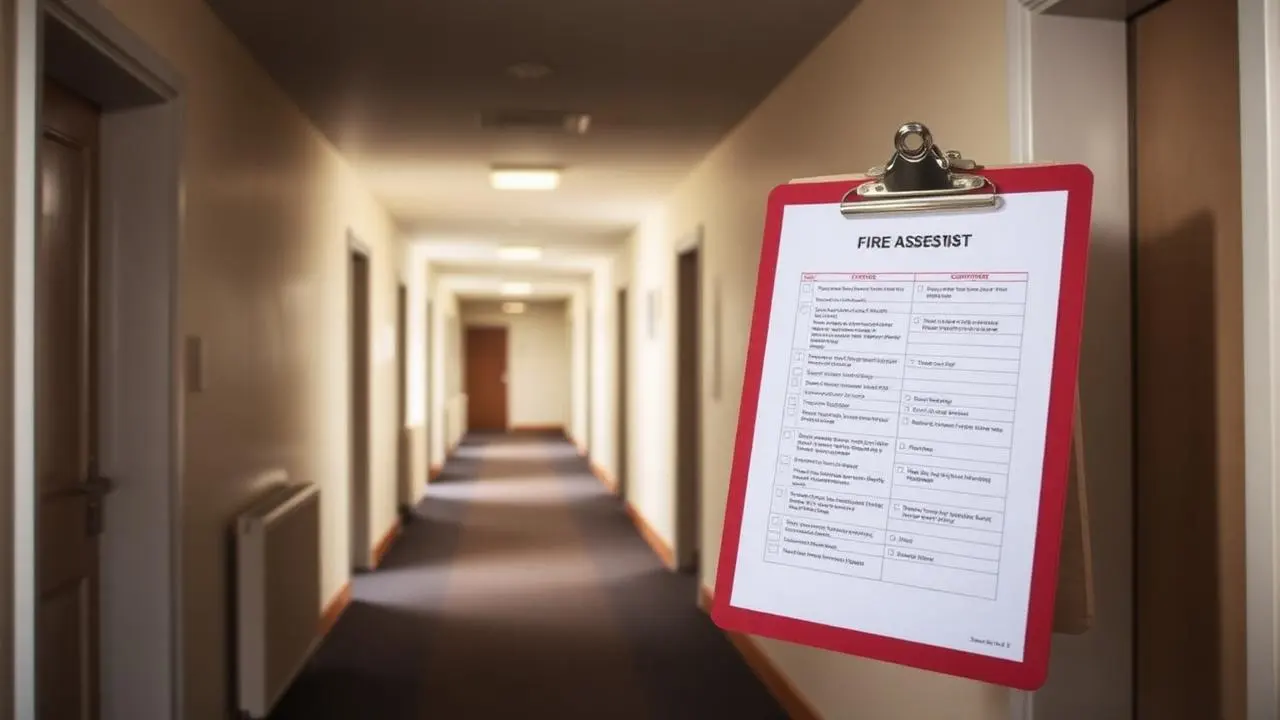
The structure is designed to make the significant findings and required actions immediately visible, rather than buried in prose. A well-structured report should let a busy managing agent or enforcement officer understand the key risks and required actions within a few minutes of opening it, without reading every page in detail.
A description of the premises, its use, construction and occupancy characteristics.
Identification of fire hazards and of the people at risk, including anyone especially vulnerable.
Evaluation of the risk against the general fire precautions already in place.
A record of significant findings, each linked to photographic evidence.
A risk rating for the premises as a whole (commonly expressed as trivial, tolerable, moderate, substantial or intolerable).
A prioritised action plan with recommended timescales for each finding — typically immediate, short-term (within one month), medium-term (within three to six months) and long-term.
Details of the assessor, their competence, and the date of the next review.
The buildings behind this advice
Housing assessments are not door certificates
PAS 79-2:2020 addressed housing fire risk assessment, not standalone fire-door inspection. It was withdrawn; BSI describes BS 9792:2025 as its revised conversion to a British Standard. Routine door checks should follow the relevant government guidance and agreed scope. Neither an FRA methodology nor an operational inspection creates product certification.
Distinguish the building FRA from recurring door checks.
Record door observations and access limitations.
Use appropriate technical evidence for suitability questions.
How to check a report you have already been given
If you already have a fire risk assessment and want to sense-check whether it will hold up, look for the structural markers of PAS 79 compliance rather than taking the provider's word for it. A short claim of compliance on the cover page proves very little on its own.
Does it state explicitly that it follows PAS 79 methodology?
Is there a clear, numbered action plan with dates, not just narrative paragraphs?
Are significant findings each supported by a photograph?
Is there an overall risk rating for the building?
Is the assessor named, with their qualifications and registration stated?
Five-minute check of an existing report
Overall risk rating stated clearly on page one or twotrivial through to intolerable
Numbered action plan with datesimmediate, one month, three to six months, long term
Photographs against each significant findingnot just a generic photo appendix
Assessor named with qualificationsIFSM, IFE or equivalent registration
Review date statedusually 12 months for most buildings
PAS 79 versus other standards you may see referenced
It is worth distinguishing PAS 79 from other standards frequently mentioned alongside it. BS 9999 provides guidance on fire safety design and management for buildings generally. BS 5839 covers fire detection and alarm systems specifically. LACORS guidance addresses HMOs specifically. PAS 79 sits alongside these as the reporting and methodology standard for the assessment process itself, drawing on the technical content of the others where relevant.
Standard
What it covers
Relationship to PAS 79
PAS 79-1
General fire risk assessment methodology and reporting
The core standard this guide covers
BS 9792:2025
Housing fire risk assessment
Revised conversion of withdrawn PAS 79-2:2020
BS 9999
Fire safety design and management guidance
Technical reference PAS 79 draws on
BS 5839
Fire detection and alarm systems
Technical reference for alarm category findings
LACORS
HMO-specific fire precautions
Applied within a PAS 79-structured HMO report
Why some reports still fall short of PAS 79 in practice
Even where a provider claims PAS 79 compliance, we sometimes see reports that use the terminology loosely without the underlying rigour — a stated risk rating with no clear reasoning behind it, an action plan without realistic timescales, or photographic evidence that does not actually correspond to the findings described. This tends to happen most with very low-cost, high-volume providers who prioritise turnaround speed over the time it takes to do a proper walk-through and write it up thoroughly. It is not that PAS 79 itself is complicated to follow; it is that following it properly takes time on site and in the write-up, and that time has to be paid for somewhere.
What this means when commissioning a new assessment
When commissioning a fire risk assessment, it is reasonable to ask directly whether the report will follow PAS 79-1 methodology, and to ask to see an anonymised sample report before booking if you have not worked with the provider before. A provider confident in the quality of their work will have no difficulty showing you a redacted example, and doing so before you commit is a far better time to find out than after paying for a thin report that will not stand up to scrutiny from a licensing officer, insurer or, in the worst case, a court. It is also worth asking who will actually be carrying out the assessment and writing the report, rather than assuming the person you speak to on the phone is the same person who will visit site — larger providers sometimes subcontract site visits to associates of variable experience, and the quality of the finished report tends to track the competence of whoever actually walked the building far more closely than the reputation of the company issuing the invoice.
How PAS 79 evolved after Grenfell
The version of PAS 79 in general use today reflects a series of updates made in the years following the Grenfell Tower fire, as the industry, government and fire and rescue services worked through what a genuinely sufficient assessment needed to cover for residential blocks specifically. The most significant of these was the publication of PAS 79-2:2020 for housing FRA, later withdrawn and converted to BS 9792:2025, but the general methodology in PAS 79-1 was also sharpened, with greater emphasis on compartmentation, external wall considerations, and clearer expectations around what evidence should sit behind a stated risk rating rather than a rating being asserted without a visible chain of reasoning. Understanding this history matters practically, because a report written against an older edition of the standard, or by an assessor who has not kept pace with the revisions, can look superficially compliant while missing detail that current guidance expects.
How PAS 79 methodology shapes the site visit itself
Because PAS 79 dictates the eventual structure of the report, it also shapes how a competent assessor conducts the site visit that produces it — the walk-through is not a free-form tour but a systematic progression through the building designed to generate the specific categories of finding the report will need. An assessor working to PAS 79 will typically start at the external approach and final exits, move through common parts floor by floor, examine plant rooms and risers where accessible, and finish with a review of management arrangements and documentation, rather than wandering the building in whatever order seems convenient on the day.
External approach, boundary and access for fire and rescue service appliances.
Final exits and escape route width, signage and clearance at ground level.
Each common parts floor in turn: corridors, stairs, service risers, any lobbies.
Plant rooms, bin stores and other ancillary areas accessible without specialist entry.
Fire doors on the common escape route, assessed against the relevant checklist.
A closing review of management documentation: servicing records, previous assessments, evacuation strategy.
Common misconceptions about PAS 79
A few misunderstandings come up repeatedly when we discuss PAS 79 with managing agents and freeholders, and it is worth addressing them directly rather than leaving them to cause confusion later. The most common is assuming PAS 79 itself sets specific technical standards — for alarm categories, fire door ratings or escape distances — when in fact it is a methodology and reporting standard that draws on other technical standards (BS 5839, BS 9999, Approved Document B and others) rather than setting new technical thresholds of its own.
PAS 79 does not set new technical fire safety standards; it structures how an assessment against existing standards is carried out and reported.
Following PAS 79 does not itself certify a building as fire safe; it certifies that the assessment process followed a recognised methodology.
PAS 79 compliance is not something BSI audits or certifies on a per-report basis; it is a self-declared methodology followed by the assessor.
A PAS 79 structured report can still contain incorrect technical judgements if the assessor lacks the competence to apply it properly.